Trenvora Pest ManagementTrenvora Pest Management

Crawl Space Encapsulation Moisture Defense Raleigh

Crawl space encapsulation moisture defense operates as a foundational safeguard against structural pest activity in Wake County. In historic and mature Raleigh neighborhoods such as Historic Oakwood, Mordecai, and…
Get My Free Estimate →(984) 742-7171
Crawl Space Encapsulation Moisture Defense in Raleigh, NC
Quick answer
  • Scope includes soil grading assessment, installation of a 12 to 20-mil reinforced vapor retarder, foundation wall sealing, seam taping, and subfloor timber moisture readings.
  • On-site diagnostic inspection requires 45 to 60 minutes; full encapsulation projects typically conclude within 2 to 4 consecutive business days.
  • Pricing starts at a minimum charge of $250 for basic barrier adjustments, with full encapsulation installations averaging between $3,500 and $9,500 depending on crawl space square footage.
  • Debris removal covers damp ground insulation, rotten timber fragments, organic nesting materials, and existing failing moisture sheets.
  • Service coordination occurs via telephone evaluation at (984) 742-7171 or through direct property assessment booking.

Crawl space encapsulation moisture defense operates as a foundational safeguard against structural pest activity in Wake County. In historic and mature Raleigh neighborhoods such as Historic Oakwood, Mordecai, and Boylan Heights, crawl spaces constructed over red clay retain runoff from severe Piedmont summer thunderstorms. When crawl space relative humidity exceeds 70%, subfloor wood joists absorb moisture, elevating wood moisture content above the 18% to 20% threshold where subterranean termites and wood-decay fungi thrive. Traditional foundation venting pulls warm, humid outdoor air directly under cool subfloors, causing condensation along ducts and sill plates. Sealing crawl space foundation vents, securing heavy-mil polyethylene across 100% of exposed ground surfaces, and integrating continuous moisture defense drops crawl space relative humidity below 55%, halting the damp conditions that invite pest colonies.

Selecting a partial moisture barrier versus full crawl space encapsulation depends on structural moisture readings and pest pressure. A continuous 6-mil poly ground cover fits properties in newer subdivisions such as Southpoint Ridge, Brier Creek, or Hedingham that exhibit dry foundation walls and require basic baseline termite inspection clearance; the trade-off is lower upfront cost against zero protection against ambient humidity infiltration. Full crawl space encapsulation, incorporating sealed foundation walls, taped structural piers, a heavy-duty 12 to 20-mil crawl space liner, and an automated ENERGY STAR crawl space dehumidifier, fits homes in Five Points, Cameron Village, North Hills, and Hayes Barton experiencing recurring wood-destroying insect activity, buckled interior hardwoods, or damp odors. While complete encapsulation requires higher initial capital, it removes the moisture reservoir that sustains subterranean termite tubes, smoky brown cockroaches, and structural rot without reliance on repeated broad-spectrum indoor chemical sprays.

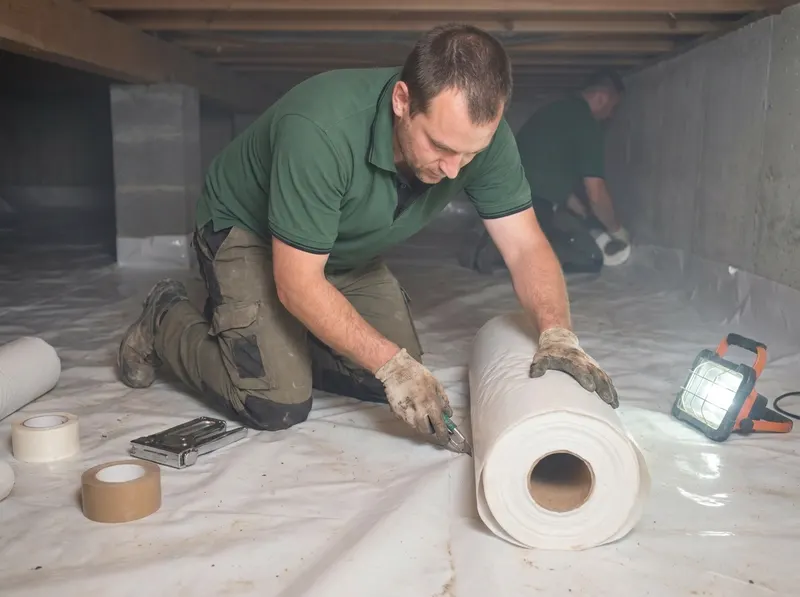
Execution follows an objective, technical sequence to ensure structural integrity across Wake County soil profiles. 1. Technicians measure structural framing moisture percentages with pin-probe hydrometers to document baseline moisture prior to installation. 2. Field personnel clear organic debris, failing fiberglass insulation, and standing ground moisture from the crawl bed. 3. Installers grade uneven earth, pin a reinforced crawl space vapor barrier across the footprint, and wrap all internal load-bearing masonry piers. 4. Wall liners attach directly to concrete block or brick foundation walls with mechanical fasteners, leaving a continuous 3-inch gap below sill plates for termite inspection visibility as required by North Carolina residential building codes. 5. Technicians seal all outer foundation perimeter vents and install an automated condensation-drainage dehumidifier set to maintain 50% relative humidity.

Crawl Space Encapsulation Moisture Defense cost in Raleigh

Minimum service visit and localized vapor barrier repair$250 to $450
Standard vapor barrier replacement (6-mil to 10-mil, up to 1,500 sq ft)$1,200 to $2,400
Full sealed crawl space encapsulation (12-mil to 20-mil, up to 1,500 sq ft)$3,500 to $6,800
Large home crawl space encapsulation with commercial dehumidifier (1,500 to 2,800 sq ft)$6,800 to $10,500
Dedicated commercial-grade crawl space dehumidifier unit and direct line plumbing$1,400 to $2,300

Every job gets a firm, written price after a free on-site visit.

Common questions

Why does Raleigh humidity make crawl space encapsulation necessary for pest defense?
Raleigh summers produce sustained relative humidity levels exceeding 80%, driving warm air through foundation vents where it condenses on cool subfloors. This condensation elevates subfloor wood moisture past 20%, which provides the hydration required for subterranean termites and wood-boring beetles to consume structural framing.
How does encapsulation prevent termite damage in Historic Oakwood and Mordecai homes?
Encapsulation maintains framing timber moisture below 14%, creating an arid zone beneath older crawl spaces that denies subterranean termites the moisture they require to survive while feeding on wood. Technicians maintain an intentional 3-inch inspection gap at the top of foundation walls so termite mud tubes remain instantly visible.
What is the minimum cost for crawl space moisture service in Raleigh?
The minimum charge for any crawl space moisture service, inspection adjustment, or localized seam repair in Raleigh is $250. Comprehensive whole-home encapsulations require an on-site measurement to deliver a firm written proposal based on exact square footage, crawl height, and drainage conditions.
Can encapsulation eliminate musty smells inside Cameron Village or North Hills living areas?
Encapsulation eliminates damp odors by stopping the stack effect, which draws up to 50% of first-floor indoor air directly from the crawl space. Sealing the earth with an airtight 12 to 20-mil vapor retarder prevents soil gases and moisture vapors from migrating into living spaces.
Does crawl space encapsulation require closing open vents on older Wake County homes?
Yes, closed crawl space standards require permanently sealing open exterior vents with insulated foam covers to prevent humid outside air from entering the foundation. Unsealed vents negate the mechanical performance of subfloor dehumidification systems.

Get started today

Tell us about your crawl space encapsulation moisture defense job in Raleigh and we'll send a clear, written quote, usually the same day.

Get your free pest control services quote, Raleigh

We only use your ZIP to check availability, no spam.