Subterranean termites nest underground and rely on soil moisture to survive, building mud tubes across crawlspace brick piers and concrete foundations to reach framing timber. In Raleigh's humid transition-zone climate…
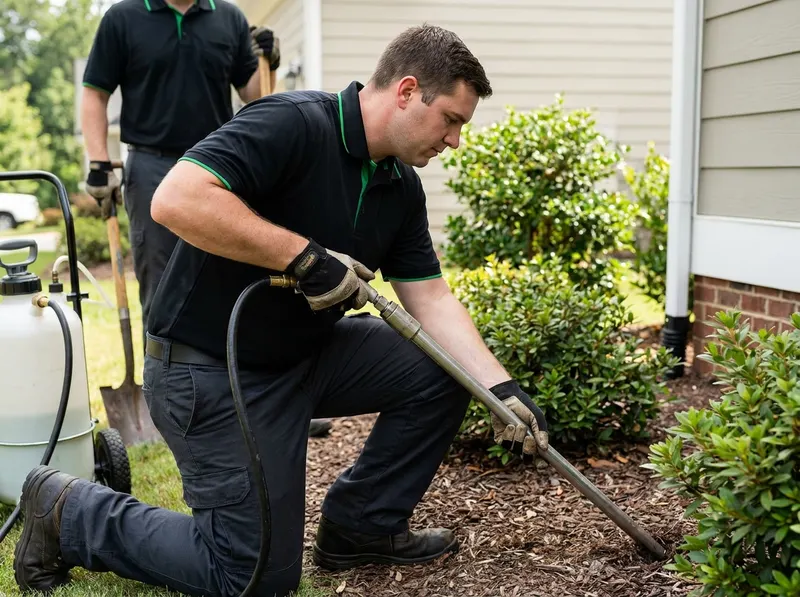
Subterranean termites nest underground and rely on soil moisture to survive, building mud tubes across crawlspace brick piers and concrete foundations to reach framing timber. In Raleigh's humid transition-zone climate and dense red clay soils, common throughout historic crawlspace residences in Mordecai, Historic Oakwood, and Boylan Heights, foundation soil requires a continuous liquid application to halt structural foraging. Non-repellent soil treatments bind tightly to the clay particles alongside the foundation walls at an industry-standard trench depth of 6 inches and width of 6 inches. Because worker termites cannot detect the active ingredient, they move directly through the treated soil band, ingest and coat themselves in the formulation, and mechanically transfer it throughout the underground colony via grooming, resulting in colony collapse within 30 to 90 days.
For slab foundations common in suburban developments across Brier Creek, Hedingham, and Southpoint Ridge, exterior trenching is supplemented with precision sub-slab rod injection. Technicians drill 1/2-inch access holes spaced roughly 12 inches apart through adjoining patio slabs, attached garage aprons, and brick veneer expansion joints to saturate the structural perimeter beneath unbroken masonry. Soil treatments serve as a continuous physical-chemical shield, contrasting with localized interior foam applications that target only active gallery chambers inside wall cavities. A standalone soil barrier addresses the sub-surface nesting source across the perimeter, whereas isolated wall treatments leave subterranean approach paths open along sill plates.
Selecting a perimeter soil termiticide barrier requires balancing immediate barrier durability with installation access. Liquid barriers deliver uninterrupted protection that remains active in undisturbed soil for 5 to 10 years, avoiding the periodic bait-station cartridge replacements required by underground monitoring systems. However, properties featuring mature root systems, heavy ground-cover vegetation, or extensive flagstone patios adjacent to exterior foundations, such as older estates in Hayes Barton, Five Points, Cameron Village, and North Hills, require physical trench clearing and precise slab penetrations. All concrete injection holes are patched flush with non-shrinking hydraulic cement immediately following injection, preserving structural slab integrity without persistent chemical odors in living quarters.
Every job gets a firm, written price after a free on-site visit.
Tell us about your subterranean termite soil treatments job in Raleigh and we'll send a clear, written quote, usually the same day.
 Trenvora Pest Management